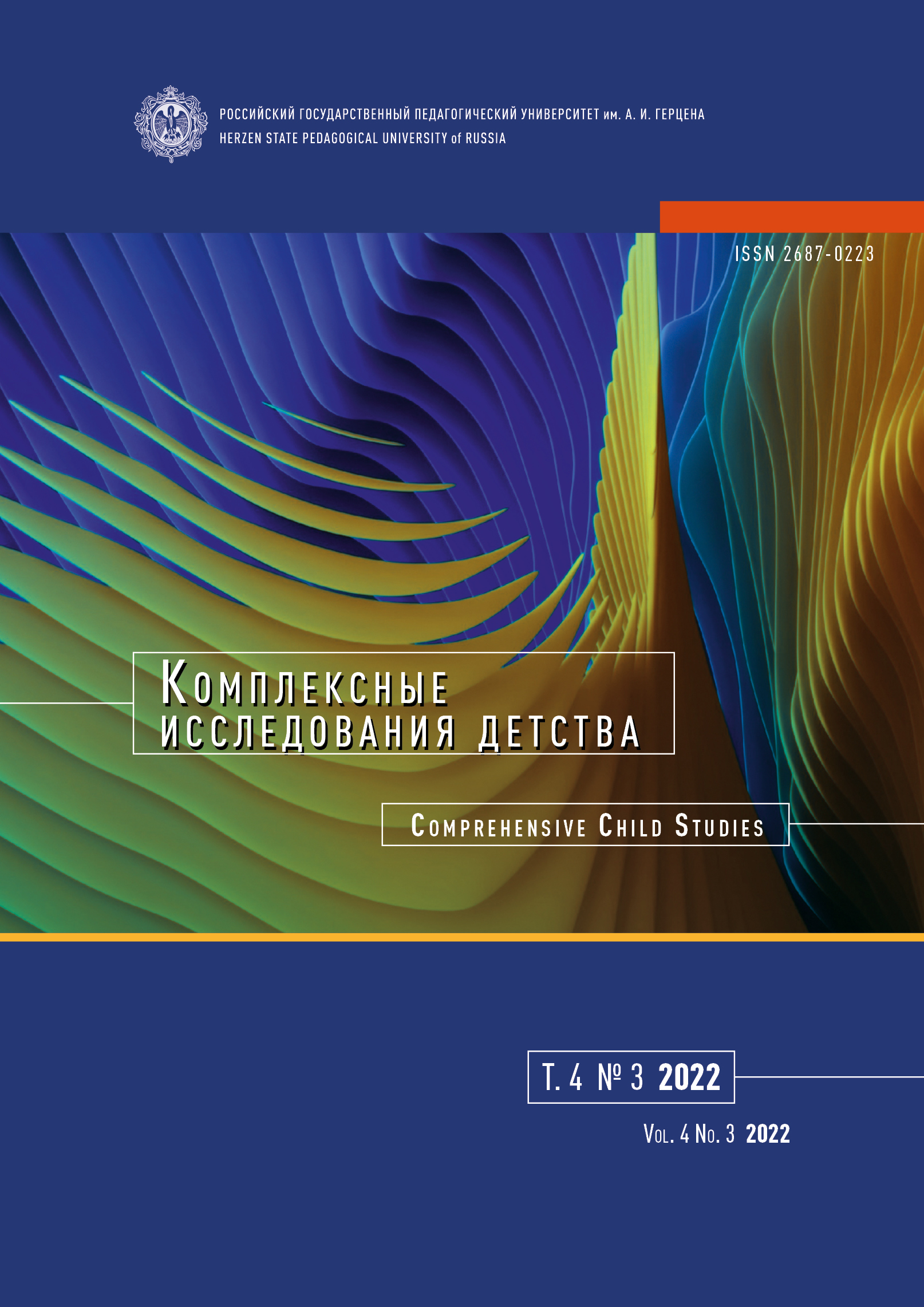
About the heading “Pen test. Participatory research experience”
Abstract
In the heading “Pen test. Participatory research experience” presents four articles written by students in grades 8–9. Three of these articles were prepared as a result of the children's participation in the Green School online participatory research project. The project got its name in connection with the interest of the children and their geography teacher I. V. Mashkina (who supervised the school project) in environmental issues.
References
ЛИТЕРАТУРА
Приказ Минобрнауки России от 17 декабря 2010 г. № 1897 «Об утверждении Федерального государственного образовательного стандарта основного общего образования» (ред. от 11.12.2020). (2010) [Электронный ресурс]. URL: https://fgos.ru/fgos/fgos-ooo/ (дата обращения 06.07.2022).
Spyrou, S. (2018) Disclosing childhoods. Research and knowledge production for a critical childhood studies. London: Palgrave Macmillan Publ., 241 p.
REFERENCES
Prikaz Minobrnauki Rossii ot 17 dekabrya 2010 g. № 1897 “Ob utverzhdenii Federal’nogo gosudarstvennogo obrazovatel’nogo standarta osnovnogo obshchego obrazovaniya” (red. ot 11.12.2020) [Order of the Ministry of Education and Science of Russia of 17 December 2010 no. 1897 “On approval of the Federal State Educational Standard for Basic General Education” (as amended on December 11, 2020)]. (2010) [Online]. Available at: https://fgos.ru/fgos/fgos-ooo/ (accessed 06.07.2022). (In Russian)
Spyrou, S. (2018) Disclosing childhoods. Research and knowledge production for a critical childhood studies. London: Palgrave Macmillan Publ., 241 p. (In English)
Downloads
Published
Issue
Section
License
Copyright (c) 2022 Alexandra G. Filipova, Margarita R. Khusnutdinova

This work is licensed under a Creative Commons Attribution-NonCommercial 4.0 International License.
The work is provided under the terms of the Public Offer and of Creative Commons public license Creative Commons Attribution 4.0 International (CC BY 4.0).
This license permits an unlimited number of users to copy and redistribute the material in any medium or format, and to remix, transform, and build upon the material for any purpose, including commercial use.
This license retains copyright for the authors but allows others to freely distribute, use, and adapt the work, on the mandatory condition that appropriate credit is given. Users must provide a correct link to the original publication in our journal, cite the authors' names, and indicate if any changes were made.
Copyright remains with the authors. The CC BY 4.0 license does not transfer rights to third parties but rather grants users prior permission for use, provided the attribution condition is met. Any use of the work will be governed by the terms of this license.